After a car accident or injury claim in Louisiana, one of the biggest legal questions is often:
“Who was at fault?”
But in many Louisiana accident cases, fault is not always completely one-sided.
Insurance companies frequently argue:
- both drivers contributed
- the injured person shares responsibility
- or damages should be reduced
This is where Louisiana’s comparative fault laws become extremely important.
Understanding how comparative fault works can directly affect:
- settlement amounts
- insurance negotiations
- injury compensation
- lawsuit outcomes
Because fault disputes are common in Louisiana accident claims, comparative fault principles may affect many types of personal injury cases
What Is Comparative Fault?
Louisiana follows a legal system called:
pure comparative fault
This means:
an injured person may still recover compensation even if they were partially responsible for the accident.
However:
their compensation may be reduced by their percentage of fault. (Citation: Louisiana Legislature – https://www.legis.la.gov/legis/law.aspx?d=109387)
Example of Comparative Fault in Louisiana
Imagine:
- total damages equal $100,000
- the injured driver is found 20% responsible
Under Louisiana comparative fault laws:
the compensation may be reduced by 20%.
Potential recovery:
$80,000
This system applies to many Louisiana injury claims, including:
- car accidents
- truck accidents
- motorcycle accidents
- pedestrian accidents
- premises liability
- offshore injury claims
Certain offshore or maritime claims may also involve comparative fault principles, although some are governed by federal law, including the Jones Act, general maritime law, or other federal statutes rather than Louisiana law. (Citation: Cornell LII – https://www.law.cornell.edu/wex/jones_act)
If you are unsure whether comparative fault applies to your situation, a Louisiana personal injury lawyer can evaluate the facts of your case.
Why Comparative Fault Matters So Much
Insurance companies often investigate fault issues carefully because fault allocations may affect the amount they pay on a claim.
Even small shifts in blame can significantly affect settlement amounts.
For example:
- a 10% reduction on a large injury case may equal thousands of dollars
- higher fault percentages can dramatically lower compensation
Because of this, fault disputes are often one of the biggest battles in injury claims.
Common Situations Where Fault Is Disputed
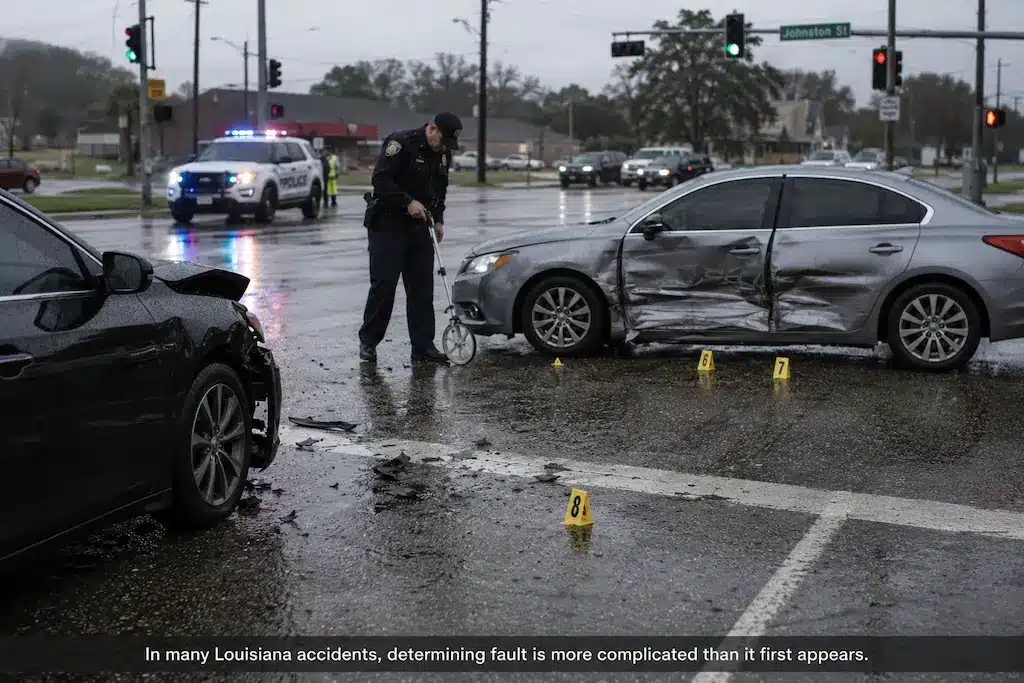
Comparative fault issues arise frequently after accidents involving:
- rear-end collisions
- lane changes
- left-turn accidents
- speeding
- distracted driving
- drunk driving
- motorcycle accidents
- pedestrian crossings
- multi-vehicle crashes
- trucking accidents
Insurance companies may attempt to argue:
- the injured person reacted improperly
- speeding contributed
- occupant conduct contributed to the severity of the incident, subject to applicable Louisiana law
- distractions existed
- road conditions played a role
How Insurance Companies Use Comparative Fault
After an accident, insurers often look for ways to shift partial blame onto injured victims.
They may argue:
- you stopped suddenly
- you were distracted
- the nature, extent, or cause of your injuries is disputed
- you delayed treatment
- you failed to avoid the accident
- your driving contributed somehow
This is one reason evidence becomes extremely important immediately after a crash.
For guidance on preserving evidence and avoiding mistakes, review what to do after a car accident in Lafayette LA.
Evidence That Helps Reduce Fault Disputes
Strong evidence can help protect injury claims from unfair fault accusations.
Important evidence may include:
- police reports
- crash scene photos
- witness statements
- surveillance footage
- traffic camera footage
- vehicle damage
- vehicle event data recorder information, when available
- cellphone records
- medical documentation
- accident reconstruction analysis
The earlier evidence is preserved, the stronger a claim may become.
Comparative Fault in Louisiana Car Accidents
Car accident claims are among the most common situations involving comparative fault disputes.
Examples:
- one driver may have been speeding
- another may have failed to yield
- both drivers may share responsibility
Even when another driver clearly caused the accident, insurers may still attempt to assign partial blame to reduce compensation exposure.
If your crash occurred in Lafayette, a Lafayette car accident lawyer can help assess how fault may affect your claim.
Comparative Fault in Truck Accident Cases
Truck accident cases often involve even more complicated liability questions.
Potentially responsible parties may include:
- truck drivers
- trucking companies
- cargo loaders
- maintenance contractors
- vehicle manufacturers
Louisiana trucking claims frequently involve:
- multiple insurance carriers
- federal transportation regulations
- severe injuries
- large financial exposure
Because truck accident claims may involve substantial damages, fault issues are often closely examined by insurers and the parties involved.
Comparative Fault in Motorcycle Accidents
Motorcycle accident cases may involve disputes regarding rider conduct and fault.
Insurance companies sometimes argue:
- riders were speeding
- lane positioning contributed
- reckless driving occurred
Even when another vehicle caused the collision, comparative fault arguments may still appear during settlement negotiations.
This makes motorcycle accident evidence especially important.
For more information, visit the firm’s motorcycle accident attorney page and read why motorcycle accidents cause severe injuries.
Comparative Fault in Pedestrian Accidents
Pedestrian accident cases can also involve shared-fault arguments.
Insurance companies may claim:
- pedestrians crossed improperly
- visibility issues existed
- distraction contributed
- traffic signals were ignored
Louisiana drivers owe duties of reasonable care toward pedestrians, and pedestrians also have legal responsibilities that may affect fault determinations.
Each case depends heavily on facts and available evidence.
Learn more about who is at fault in a pedestrian accident in Louisiana or speak with a pedestrian accident lawyer.
Louisiana Comparative Fault and Injury Compensation
Comparative fault directly affects:
- settlement negotiations
- trial outcomes
- insurance evaluations
- case value calculations
The higher the assigned fault percentage:
the lower potential compensation may become.
This is why even small factual details can become important during injury investigations.
Can You Still Recover Compensation If You Were Mostly At Fault?
Yes.
Louisiana’s pure comparative fault system generally allows an injured person to seek compensation even if they bear a large share of fault, although any recovery may be reduced by that percentage.
Why Early Statements Can Hurt Your Case
After accidents, many people unintentionally say things that insurers later use against them.
Statements like:
- “I’m sorry”
- “I didn’t see them”
- “I may have been distracted”
may later be considered as part of the overall evaluation of the circumstances, depending on the facts of the case.
This is why accident victims are often encouraged to:
- stick to facts
- avoid speculation
- understand their legal rights and obligations before providing detailed recorded statements to an insurer
How Comparative Fault Affects Settlement Negotiations
Many settlement negotiations revolve around:
fault percentages.
Insurance companies often attempt to:
- increase victim fault
- minimize injury severity
- reduce financial exposure
Meanwhile, injury claims typically rely on:
- evidence
- witness credibility
- medical documentation
- accident reconstruction
- legal strategy
Comparative fault issues can heavily influence final settlement outcomes.
Common Mistakes That Can Hurt Louisiana Injury Claims
After accidents, certain mistakes may weaken a claim or increase comparative fault arguments.
Examples include:
- delaying medical treatment
- failing to document evidence
- posting on social media
- giving recorded insurance statements
- skipping follow-up treatment
- admitting blame at the scene
Certain actions after an accident may affect how an insurance claim is evaluated.
When Should You Speak With a Louisiana Injury Lawyer?
Fault disputes can become extremely complicated — especially in cases involving:
- severe injuries
- trucking companies
- multiple vehicles
- disputed liability
- permanent disabilities
- wrongful death claims
Wrongful death claims are governed by specific Louisiana statutes and may involve additional legal considerations. (Citation: Louisiana Legislature – Wrongful Death Statutes – https://www.legis.la.gov/legis/Law.aspx?d=109371)
An experienced Louisiana personal injury lawyer may help:
- investigate fault
- preserve evidence
- negotiate with insurers
- evaluate damages
- protect against unfair blame tactics
Speak With a Lafayette Personal Injury Attorney
Comparative fault laws can significantly affect injury compensation after a Louisiana accident.
Because fault and damages issues can affect the outcome of a claim, understanding your legal rights early may be beneficial.
J. Minos Simon LTD represents Louisiana injury victims in cases involving:
- car accidents
- truck accidents
- offshore injuries
- motorcycle accidents
- pedestrian injuries
- wrongful death claims
If you were injured in Lafayette or elsewhere in Louisiana, the firm offers free case evaluations to discuss your legal options.
Past results do not guarantee future outcomes, and every case depends on its own facts and applicable law.
FAQs
What is the comparative fault in Louisiana?
Louisiana uses a pure comparative fault system, meaning injured people may still recover compensation even if they were partially responsible for the accident.
Can I still recover compensation if I was partly at fault?
Yes. However, compensation may be reduced according to your percentage of fault.
How do insurance companies use comparative fault?
Insurance companies often attempt to assign partial blame to reduce settlement payouts.
What evidence helps in comparative fault disputes?
Police reports, witness statements, photos, medical records, surveillance footage, and accident reconstruction evidence may help support injury claims.
Does comparative fault apply to truck and motorcycle accidents?
Yes. Comparative fault laws apply to many Louisiana injury cases, including truck accidents, motorcycle accidents, pedestrian accidents, and offshore injury claims.
Disclaimer
This article is provided for general informational purposes only and does not constitute legal advice. Reading this article does not create an attorney-client relationship. Laws may change, and every case depends on its unique facts and applicable law.
References
- Louisiana Legislature – https://www.legis.la.gov/legis/law.aspx?d=109387)
- Cornell LII – https://www.law.cornell.edu/wex/jones_act)
- Louisiana Legislature – Wrongful Death Statutes – https://www.legis.la.gov/legis/Law.aspx?d=109371)