After a serious truck accident, many people assume liability is simple:
The truck driver caused the crash, so the truck driver is responsible.
In reality, truck accident cases are often much more complex.
Unlike ordinary car accidents, commercial trucking operations may involve multiple companies, contractors, insurers, and third parties.
In some cases, several parties may share responsibility for a single crash.
Determining liability is one of the most important parts of a Louisiana truck accident claim because it directly affects:
- compensation
- insurance coverage
- settlement negotiations
- legal strategy
Understanding who may be responsible can help accident victims better understand how truck accident investigations work.
Why Truck Accident Liability Is More Complicated Than Car Accidents
Most car accidents involve:
- two drivers
- two insurance companies
Truck accident cases may involve:
- commercial trucking companies
- fleet operators
- cargo loading contractors
- maintenance providers
- vehicle manufacturers
- insurance carriers
- logistics companies
Truck accident claims may require reviewing factors such as driver conduct, company policies, vehicle conditions, and compliance with safety requirements. Understanding these differences is important because why truck accident cases are different from car accidents is often connected to the number of parties that may be involved.
1. The Truck Driver
The truck driver is often the first person investigated after a crash.
Drivers have a duty to operate commercial vehicles safely and follow applicable traffic laws.
Truck drivers may be liable when accidents involve:
- speeding
- distracted driving
- fatigue
- impaired driving
- unsafe lane changes
- following too closely
- failure to obey traffic signals
Common examples of truck driver negligence that causes crashes include violations of safety rules, poor decision-making, and failure to follow proper driving procedures.
Investigators often review:
- driver logs
- electronic logging devices (ELDs)
- cell phone records
- driving history
- accident reports
to determine whether driver negligence contributed to the collision.
2. The Trucking Company
In many truck accident cases, liability extends beyond the driver.
Trucking companies may be responsible when they:
- hire unqualified drivers
- fail to train employees properly
- encourage unsafe schedules
- ignore safety violations
- fail to maintain vehicles
- violate federal regulations
For example, if a company knowingly allows a fatigued driver to remain on the road, the company itself may share liability.
Because trucking companies often carry substantial insurance policies, they are frequently central to truck accident claims.
Federal trucking regulations can also impact whether a company may be held responsible. Violations involving driver qualifications, maintenance, or hours-of-service rules may become important evidence. Learn more about how federal trucking safety rules can affect your accident claim.
3. The Owner of the Truck
Sometimes the truck owner is not the same entity as the trucking company.
Commercial vehicles may be:
- leased
- rented
- owned by separate corporations
If vehicle ownership creates maintenance or safety responsibilities, the owner may potentially bear liability depending on the circumstances.
This is one reason investigators often examine ownership records early in truck accident cases.
4. Cargo Loading Companies
Improperly loaded cargo can create serious safety risks.
Cargo problems may include:
- overloaded trailers
- uneven weight distribution
- unsecured freight
- shifting cargo
- falling cargo
These conditions may contribute to:
- rollovers
- jackknife accidents
- loss of vehicle control
If a third-party company loaded the cargo improperly, it may potentially share responsibility for resulting injuries.
Because cargo-related failures are a common factor in large truck crashes, understanding the common causes of 18-wheeler accidents in Louisiana can help explain how multiple parties may contribute to a collision.
5. Vehicle Maintenance Providers
Commercial trucks require ongoing inspection and maintenance.
Mechanical failures may involve:
- brake defects
- tire failures
- steering problems
- lighting issues
- suspension defects
When maintenance contractors fail to perform necessary repairs or inspections, they may become part of a liability investigation.
Maintenance records often play an important role in truck accident claims.
6. Truck Manufacturers
Some accidents result from defective vehicle components rather than driver error.
Potential defects may involve:
- brakes
- tires
- steering systems
- electronic systems
- coupling mechanisms
In these situations, product liability claims may arise against manufacturers, distributors, or other entities involved in the design or production process.
These cases often require extensive technical investigation.
7. Trailer Owners
In some commercial trucking operations, the tractor and trailer belong to different entities.
A trailer owner may potentially share responsibility if:
- equipment defects exist
- maintenance obligations were ignored
- trailer-related failures contributed to the crash
Because ownership structures vary, investigators often examine contracts and equipment records.
8. Third-Party Contractors
Modern trucking operations frequently involve multiple contractors.
Examples may include:
- logistics providers
- dispatch companies
- maintenance contractors
- loading contractors
- transportation brokers
Depending on the facts, these parties may become relevant if their actions contributed to unsafe operating conditions.
Federal Regulations Often Play a Major Role
Commercial trucking companies must comply with regulations enforced by the:
Federal Motor Carrier Safety Administration (FMCSA)
These regulations govern areas such as:
- driver qualifications
- hours-of-service limits
- vehicle inspections
- maintenance requirements
- safety records
- drug and alcohol testing
Violations of FMCSA regulations may become important evidence in truck accident investigations.
Common Examples of Shared Liability
Truck accident cases frequently involve more than one responsible party.
Examples include:
Example 1
A fatigued driver causes a crash after exceeding legal driving limits.
Potential liability:
- driver
- trucking company
Example 2
A trailer overturns because cargo shifts during transport.
Potential liability:
- cargo loader
- trucking company
Example 3
Brake failure causes a collision.
Potential liability:
- maintenance provider
- truck owner
- manufacturer
How Investigators Determine Liability
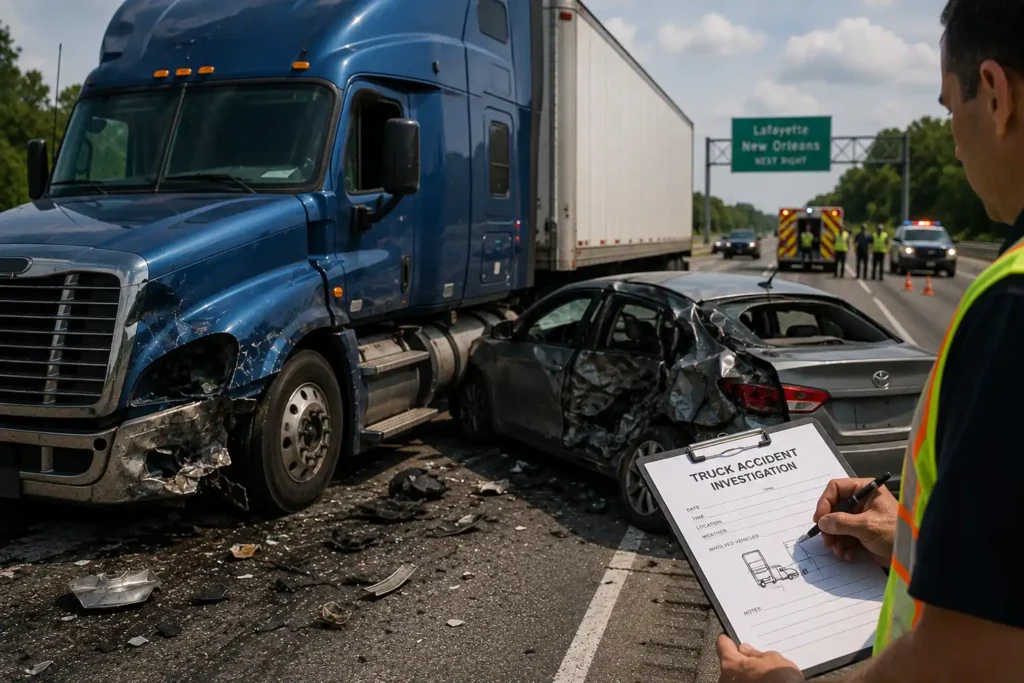
Truck accident investigations often involve reviewing:
- police reports
- driver logs
- electronic logging devices
- maintenance records
- inspection reports
- black box data
- GPS records
- witness statements
- company safety records
Because commercial trucking cases can involve substantial damages, evidence preservation is often critical.
Important evidence may include photographs, vehicle damage records, driver information, and documentation showing whether safety violations occurred.
Understanding what evidence helps prove a truck accident claim can help victims understand why preserving records and collecting information after a crash matters.
Louisiana Comparative Fault Laws
Louisiana follows a pure comparative fault system
Under Louisiana Civil Code Article 2323, multiple parties may share fault for an accident.
Liability may be allocated among:
- truck drivers
- trucking companies
- contractors
- injured motorists
- other involved parties
Because fault percentages can affect compensation, truck accident liability disputes are often heavily contested.
Why Insurance Companies Fight Truck Accident Claims
Truck accident cases frequently involve:
- catastrophic injuries
- large insurance policies
- significant financial exposure
As a result, insurers often:
- dispute fault
- challenge injuries
- minimize damages
- shift blame
Understanding all potentially liable parties is often an important part of maximizing available compensation.
What Compensation May Be Available?
Depending on the circumstances, truck accident victims may pursue compensation for:
Medical Expenses
- emergency treatment
- surgery
- rehabilitation
Lost Income
- missed work
- reduced earning capacity
Pain and Suffering
- physical pain
- emotional distress
Future Damages
- future medical care
- permanent disabilities
Property Damage
- vehicle repairs
- replacement costs
Compensation depends on the specific facts of the case.
What Should You Do After a Truck Accident?
Following a truck accident:
- seek medical attention
- call law enforcement
- document the scene
- photograph vehicles and injuries
- preserve records
- identify witnesses
Trucking companies often begin investigating accidents immediately, making early evidence preservation especially important.
When Should You Contact a Louisiana Truck Accident Lawyer?
Legal guidance may be especially important when:
- injuries are serious
- commercial trucks are involved
- liability is disputed
- multiple parties may be responsible
- insurance companies deny claims
- catastrophic injuries occur
Truck accident cases often require extensive investigation into both negligence and regulatory compliance.
A qualified Louisiana truck accident lawyer can help investigate the crash, identify responsible parties, collect evidence, and handle negotiations with insurance companies.
Speak With a Louisiana Truck Accident Attorney
Truck accidents can leave victims facing:
- overwhelming medical bills
- lost income
- long-term rehabilitation
- permanent disabilities
J. Minos Simon, LTD represents Louisiana injury victims in claims involving:
- 18-wheeler accidents
- commercial truck crashes
- catastrophic injuries
- wrongful death claims
- trucking company negligence
The firm has experience handling complex truck accident claims and helping injured victims understand their legal options. You can review examples of past case outcomes through the firm’s verdicts and settlements.
If you were injured in a Louisiana truck accident, the firm offers free consultations to discuss your legal rights and available options.
To learn more or discuss your case, you can contact J. Minos Simon, LTD for guidance.
FAQss
Who can be held responsible in a Louisiana truck accident?
Potentially responsible parties may include the truck driver, trucking company, cargo loader, maintenance provider, truck owner, trailer owner, or manufacturer depending on the circumstances.
Can a trucking company be liable for a driver’s actions?
Yes. Trucking companies may be responsible if negligent hiring, training, supervision, scheduling, or safety violations contributed to the accident.
What if a truck accident was caused by defective equipment?
Product liability claims may arise if defective truck components contributed to the crash.
Why do truck accident cases involve multiple defendants?
Commercial trucking operations often involve numerous companies responsible for different aspects of vehicle ownership, maintenance, cargo handling, and transportation.
What evidence helps prove truck accident liability?
Evidence may include driver logs, black box data, maintenance records, inspection reports, witness statements, police reports, and FMCSA compliance records.
Recommended Authority Sources
- Federal Motor Carrier Safety Administration (FMCSA)
- Louisiana Legislature
- Louisiana Civil Code Article 2323
- National Highway Traffic Safety Administration (NHTSA)
- Louisiana State Police Commercial Vehicle Enforcement
Disclaimer: This article is for informational purposes only and does not constitute legal advice. Every truck accident case is unique. Consult a qualified Louisiana attorney regarding your specific situation.