If you’ve been injured while working offshore, aboard a vessel, or in the maritime industry, you may hear someone mention:
“You should be getting Maintenance and Cure.”
Many offshore workers know the phrase but aren’t entirely sure what it means.
Some assume it’s a form of workers’ compensation.
Others think it’s part of a Jones Act lawsuit.
In reality, Maintenance and Cure is one of the oldest and most important protections available to qualifying seamen under maritime law.
For injured offshore workers, it can provide:
- medical treatment
- financial support during recovery
- protection while unable to return to work
Understanding how Maintenance and Cure works can be critical after a maritime injury.
What Does Maintenance and Cure Mean?
Maintenance and Cure is a legal obligation that maritime employers may owe to qualifying seamen who become injured or ill while serving a vessel.
The doctrine has existed in maritime law for centuries and remains a fundamental protection for maritime workers today.
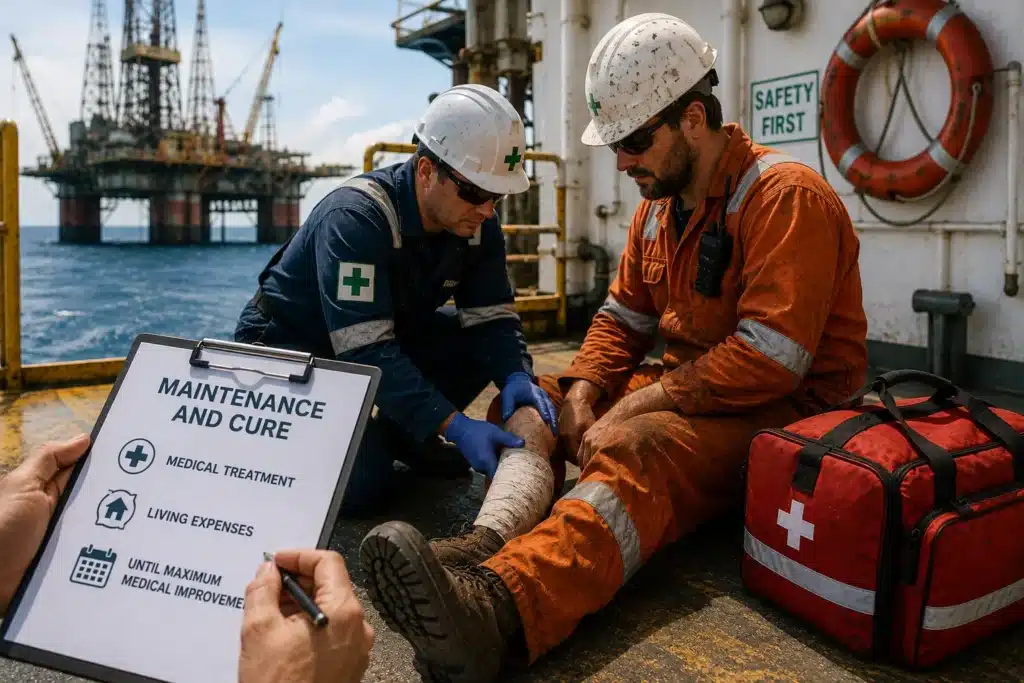
Maintenance and Cure consists of two separate benefits:
Maintenance
and
Cure
Each serves a different purpose.
What Is Maintenance?
Maintenance refers to the daily living expenses an injured seaman incurs while recovering and unable to work.
Historically, a vessel provided crew members with:
- food
- lodging
- basic necessities
When an injured worker is no longer living aboard the vessel, Maintenance is intended to help replace those necessities.
Maintenance may help cover reasonable expenses such as:
- rent
- mortgage payments
- utilities
- food
- basic household expenses
The amount varies depending on the circumstances of the case.
What Is Cure?
Cure refers to medical care and treatment related to the worker’s injury or illness.
This may include:
- emergency treatment
- hospital care
- physician visits
- surgery
- rehabilitation
- physical therapy
- prescription medications
- diagnostic testing
The goal is to provide reasonable medical treatment until the worker reaches a certain point in recovery.
Do You Have to Prove Someone Was at Fault?
One of the most important aspects of Maintenance and Cure is that:
Fault usually does not matter.
Unlike many personal injury claims, an injured seaman generally does not have to prove:
- employer negligence
- vessel negligence
- unsafe conduct
to qualify for Maintenance and Cure benefits.
In many situations, benefits may be available simply because the injury occurred while the worker was serving the vessel.
This makes Maintenance and Cure very different from a Jones Act negligence claim.
For a better understanding of how Jones Act protections compare with other workplace injury systems, see Jones Act vs Workers’ Compensation: Which Applies to Offshore Workers?
Who Qualifies for Maintenance and Cure?
Generally speaking, Maintenance and Cure applies to:
Seamen
under maritime law.
Workers who may qualify include:
- deckhands
- captains
- vessel engineers
- tugboat crew members
- offshore supply vessel workers
- commercial fishing crews
- certain offshore maritime employees
Not every offshore worker automatically qualifies.
Eligibility often depends on:
- job duties
- vessel assignment
- employment relationship
- connection to a vessel in navigation
Workers who need to determine whether they meet seaman requirements can review who qualifies as a seaman under the Jones Act.
Does the Injury Have to Happen at Sea?
Not necessarily.
Many injured workers mistakenly believe they must be injured in the middle of the Gulf of Mexico to qualify.
The key issue is often whether the worker was:
In the Service of the Vessel
at the time of the injury or illness.
Courts have interpreted this concept broadly in many situations.
As a result, some injuries occurring on docks, during crew transfers, or while performing vessel-related duties may still qualify.
What Types of Injuries Can Qualify?
Maintenance and Cure may apply to many different injuries and illnesses.
Examples include:
Slip and Fall Injuries
Wet decks, ladders, and vessel walkways can create hazards.
Back and Neck Injuries
Heavy lifting and offshore labor frequently cause spinal injuries.
Head Injuries
Traumatic brain injuries and concussions can occur during vessel operations.
Burn Injuries
Fires, explosions, and equipment accidents may result in serious burns.
Learn more about offshore explosion and fire injuries.
Crush Injuries
Heavy machinery and industrial equipment create significant risks.
Occupational Illnesses
Certain illnesses that develop while serving the vessel may also qualify.
How Long Do Maintenance and Cure Benefits Last?
Maintenance and Cure benefits do not continue indefinitely.
Generally, they continue until the injured worker reaches:
Maximum Medical Improvement (MMI)
This is one of the most important concepts in maritime injury law.
What Is Maximum Medical Improvement?
Maximum Medical Improvement means that the worker’s condition has improved as much as reasonably expected through medical treatment.
Importantly:
MMI does not necessarily mean full recovery.
A worker may still experience:
- chronic pain
- permanent limitations
- disability
and yet still be considered at Maximum Medical Improvement.
Once MMI is reached, Cure obligations often end.
What Happens If an Employer Stops Paying Maintenance and Cure?
Disputes sometimes arise when employers:
- deny benefits
- stop payments
- challenge medical treatment
- argue that MMI has been reached
These disputes can create significant financial pressure for injured workers who are already unable to work.
Maritime law generally imposes important obligations on employers regarding Maintenance and Cure.
When disputes occur, legal guidance may become necessary.
Can You Receive Maintenance and Cure and File a Jones Act Claim?
Often, yes.
Maintenance and Cure and Jones Act claims are separate legal remedies.
An injured seaman may potentially pursue:
Maintenance and Cure
for living expenses and medical treatment.
Jones Act Negligence Claims
for injuries caused by employer negligence.
Unseaworthiness Claims
for unsafe vessel conditions.
Many maritime injury cases involve more than one of these claims.
Workers dealing with unsafe vessel conditions may need to understand what makes a vessel unseaworthy and how vessel conditions may affect their rights.
Maintenance and Cure vs Workers’ Compensation
Offshore workers frequently confuse these systems.
However, they are very different.
Workers’ Compensation
Typically provides statutory benefits under state law.
Maintenance and Cure
Arises from federal maritime law and applies to qualifying seamen.
Unlike traditional workers’ compensation systems, Maintenance and Cure exists independently of state workers’ compensation laws.
Common Offshore Accidents That Lead to Maintenance and Cure Claims
Louisiana’s offshore industry creates numerous injury risks.
Common examples include:
- vessel slips and falls
- offshore crane accidents
- lifting injuries
- equipment failures
- crew transfer accidents
- vessel collisions
- offshore explosions
- deck accidents
- machinery injuries
Many of these incidents result in both medical treatment and lost work time.
For more information about injuries that can occur in offshore environments, see common offshore injuries involving oil rigs and vessels.
What Evidence Helps Support a Maintenance and Cure Claim?
Important evidence often includes:
Medical Records
- diagnoses
- treatment plans
- physician recommendations
Employment Records
- vessel assignments
- work schedules
- job descriptions
Accident Reports
- incident documentation
- witness statements
Vessel Records
- crew rosters
- vessel logs
- assignment records
Strong documentation can help establish eligibility and support benefit claims.
Why Maintenance and Cure Matters for Louisiana Offshore Workers
Louisiana serves as one of the largest offshore energy and maritime regions in the United States.
Thousands of workers are employed in:
- offshore oil and gas operations
- vessel transportation
- marine logistics
- Gulf Coast maritime industries
Because offshore work often involves significant physical risks, Maintenance and Cure remains one of the most important protections available after a maritime injury.
When Should You Contact a Louisiana Maritime Injury Lawyer?
Legal guidance may be especially important when:
- Maintenance and Cure benefits are denied
- payments stop unexpectedly
- medical treatment is disputed
- seaman status is challenged
- serious injuries occur offshore
Maritime law differs significantly from ordinary personal injury and workers’ compensation systems.
Understanding your rights early can help protect both your medical care and financial recovery.
If you were involved in a vessel-related incident, a Louisiana Maritime Accident Attorney can help you understand your legal options.
Speak With a Louisiana Jones Act Attorney
An offshore injury can leave workers facing uncertainty about medical treatment, income, and future employment.
J. Minos Simon, LTD represents Louisiana maritime workers in claims involving:
- Maintenance and Cure disputes
- Jones Act injuries
- offshore accidents
- vessel injuries
- maritime negligence claims
When maritime accidents result in fatalities, families may also need to understand their rights under maritime wrongful death claims.
If you were injured while working offshore or aboard a vessel, the firm offers free consultations to discuss your legal rights and options.
You can contact the firm to learn more about your legal options after a maritime injury.
FAQs
What is Maintenance and Cure?
Maintenance and Cure is a maritime law remedy that may require employers to provide living expenses and medical treatment to qualifying injured seamen.
Do I have to prove negligence to receive Maintenance and Cure?
Generally no. Maintenance and Cure benefits are often available regardless of who caused the injury.
What expenses does Maintenance cover?
Maintenance may help cover reasonable living expenses such as housing, utilities, and food while recovering from an injury.
What medical treatment does Cure cover?
Cure generally refers to reasonable medical treatment related to the injury until Maximum Medical Improvement is reached.
Can my employer stop paying Maintenance and Cure?
Disputes sometimes arise regarding eligibility, treatment, or Maximum Medical Improvement. The legality of terminating benefits depends on the facts of the case.
Recommended Authority Sources
- Jones Act (46 U.S.C. § 30104)
- General Maritime Law
- Cornell Law School Legal Information Institute
- Vaughan v. Atkinson
- Atlantic Sounding Co. v. Townsend
- Fifth Circuit maritime decisions
Disclaimer: This article is provided for informational purposes only and does not constitute legal advice. Maritime law is highly specialized, and eligibility for Maintenance and Cure benefits depends on the specific facts of each case. Reading this article does not create an attorney-client relationship. Consult a qualified maritime attorney regarding your situation.